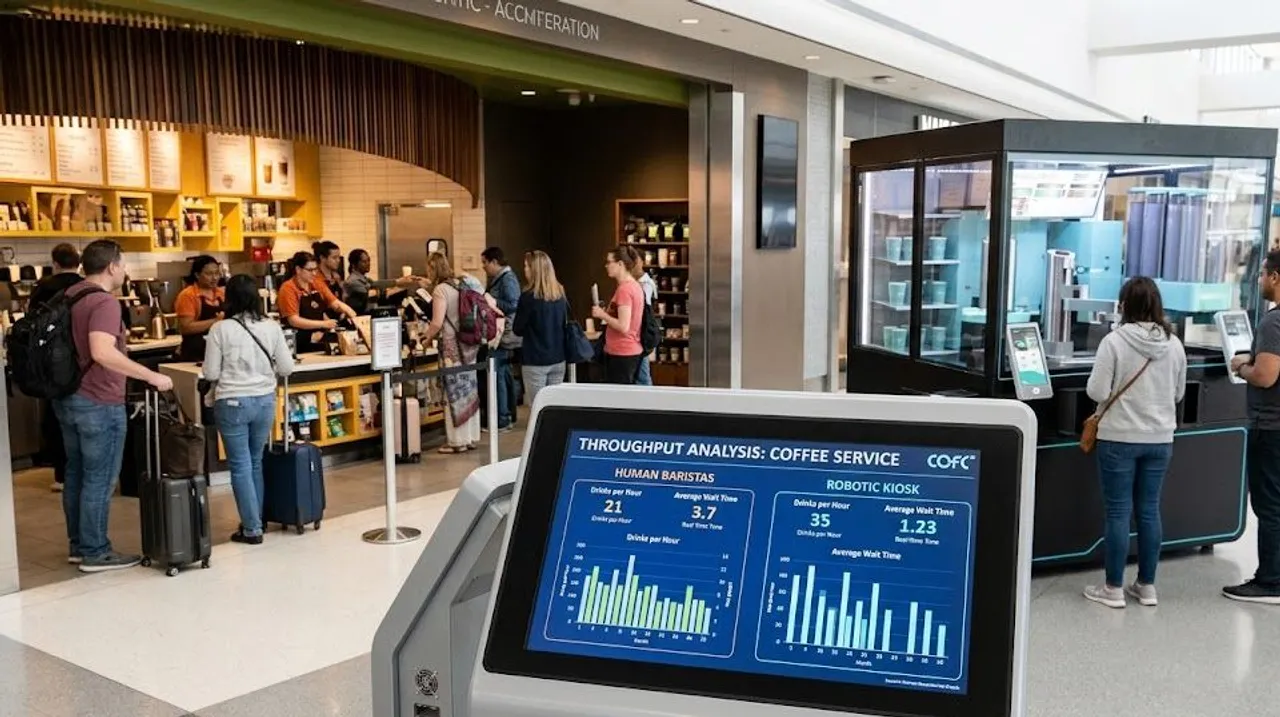
Short answer: at peak, no. A practised barista on a two-group machine will clear a rush faster than any single robotic kiosk in this class, and can be joined by a second person when the queue grows.
That is not the argument for automation in a terminal, and pretending otherwise is how concessions end up under-sized. The real argument is about trading hours, not speed. But since throughput is the number everyone asks about first, it is worth explaining what it actually measures.
Where a cups-per-hour figure comes from
Rated throughput is not a measurement. It is arithmetic: 3,600 divided by the machine’s serve time.
The Artidyn Iris produces a drink in 51 seconds, so it is rated at 70 cups an hour. A 90-second machine is rated at 40. That is the whole calculation, and it assumes a continuous queue, no restocking, and no time spent at the touchscreen.
Every vendor in this market quotes the same arithmetic. Very few explain that it is arithmetic.
What reduces it in a real terminal
Consumables run out first. A 150-cup magazine at 70 cups an hour is roughly two hours of uninterrupted service. Milk usually binds sooner. Any claim that one of these machines runs for days between restocks is describing a quiet site, not a busy one — at concourse volumes the restock lands inside the morning peak, and it needs to be planned for rather than discovered.
Ordering time is not serve time. A passenger deciding at the screen adds fifteen to forty seconds that the rated figure ignores entirely. QR pre-ordering from the gate removes most of it and is the cheapest throughput improvement available to a pitch.
Drink mix matters. Milk drinks take longer than an americano. A wave of flat whites will not hit the rated number.
Plan on roughly seventy per cent of the rated figure as sustained throughput across a real hour. For a 70 cups/hour machine that is somewhere near 45 to 50 actual drinks.
Why a person still wins the rush
A barista overlaps operations in a way a single-armed machine cannot: grinding the next dose while the current shot pulls, steaming milk for two drinks at once, calling orders ahead down the queue. That parallelism is why human throughput climbs under pressure and machine throughput does not.
It is also why human capacity scales cheaply and machine capacity does not. Adding a second person roughly doubles output. Adding a second machine costs another $27,000.
Where the machine wins decisively
The first departure wave leaves before any concession can profitably open, and the last arrivals land after the rota has gone home. Those hours are not lost to weak demand. They are lost because a shift at that hour costs more than it returns.
A machine trades through both windows at the same daily cost it already carries. That is the argument — not that it is faster, but that its cost is indifferent to the clock. Airside sites also have the recruitment problem in its sharpest form: background checks, unsociable starts, and a commute through security. Pitches that cannot fill a rota get automated first, whatever the throughput comparison says.
Sizing a pitch
Size to the busiest hour, never the daily total. It is the most expensive mistake in this environment and the easiest to avoid.
If your peak is 150 drinks in sixty minutes, that is three machines or a staffed bar — one unit will not do it, and a vendor who says otherwise is quoting you the arithmetic rather than the outcome. If your peak is forty and your trading day is twenty hours, automation is very likely the right call.
The airport and transit siting guide covers the compliance questions that follow — floor loading, dedicated circuits, evacuation behaviour, and getting a crate through an airside gate.
Read next: Robot baristas for airports and transit hubs explains why rated throughput and sustained throughput are different numbers, and how to size a pitch to its busiest hour. See also the robot barista buyer’s guide.