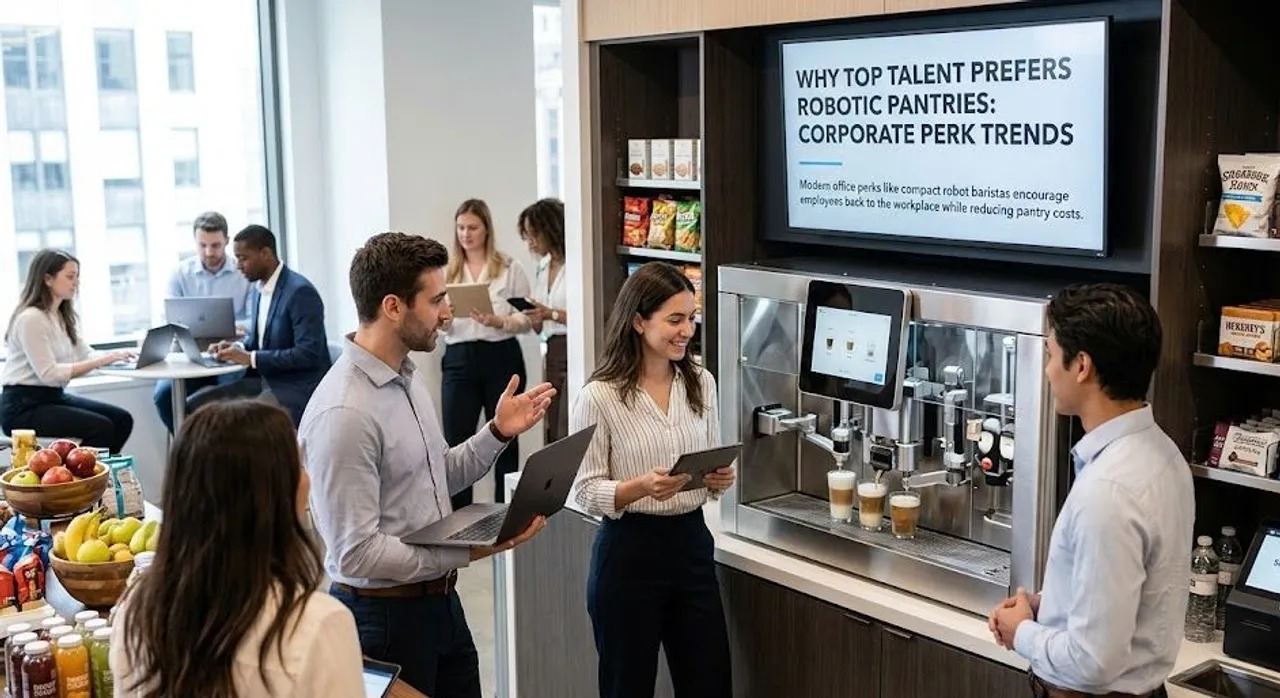
Office coffee sits awkwardly between a cost line and a retention line. Urns and pod machines are cheap and nobody values them. A staffed micro-cafe is valued and rarely survives a budget review. Meanwhile people walk to a cafe and back, and the employer pays for that time without ever recording it.
A robotic pantry is an unusual proposition in that context, because the usual case for automation — that it trades hours a person cannot — matters less in an office than the plain cost per cup.
The number that decides it
Most office deployments are free-vend: no payment, no revenue, no card processing. That removes payback from the conversation entirely and leaves one figure worth arguing about.
At sixty cups a day, an Iris Pro amortised across five years — plus consumables, a thirty-minute daily service round, and power and connectivity — delivers a cup at roughly $1.10. A nearby cafe is somewhere near $4.75. On those assumptions the same drink costs the business about a quarter of what a subsidised cafe allowance would.
We publish the full model and its assumptions rather than the headline figure alone, because the figure moves sharply with volume and we would rather you checked it than trusted it.
Why volume decides everything
The service round and the machine are fixed costs. Consumables are not. So cost per cup falls quickly as volume rises and climbs just as quickly when it does not — halve the cups and the all-in figure roughly doubles.
This is the single most common reason an office deployment disappoints, and it is entirely knowable in advance. Model on real attendance rather than headcount: a 300-person office at forty per cent attendance is a 120-person office, and hybrid patterns have made that gap wider than most facilities plans assume.
Below roughly twenty-five cups a day, the honest recommendation is a good bean-to-cup machine instead. We say so when we see it.
The peak that breaks it
A machine in this class sustains something like 45 to 50 real cups an hour once ordering time and restocking are counted.
An office where everyone starts at nine will want most of its coffee between 08:45 and 09:15. Three hundred people concentrated into that window need roughly ten drinks a minute, which no single unit delivers. Offices with staggered arrivals are far better candidates than those with a fixed start time — and that, rather than headcount, is the first question worth asking.
Waste, briefly
The sustainability case is real but narrower than it is usually sold. Bean-to-cup extraction to order avoids two specific kinds of waste: the packaging that pod systems generate, and the batch of drip coffee that goes stale and gets poured away at eleven.
That is a genuine improvement on both alternatives. It is not, on its own, an environmental programme, and we would not build a business case on it.
What it does not do
Worth being clear, because these machines get oversold:
- Payment is QR and mobile, not a corporate badge tap. If badge integration or perk-credit tracking is a requirement, confirm it against the specification rather than assuming it.
- It still needs a person. Roughly thirty minutes a day for restocking, waste, and wipe-down. If no facilities team owns that round by name, the machine will be out of milk within a month. This is the most common failure we see, and it has nothing to do with the technology.
- It has a fixed recipe list. Twenty-four presets covers what most offices drink and will not take a spoken request.
The honest summary
A robotic pantry is a good deal for an office with enough people, spread arrivals, and someone who owns the daily round. It delivers cafe-grade espresso at roughly a quarter of cafe cost and removes a walk from the working day.
For an office without those three things, it is an expensive way to make coffee. The office siting guide works through which is which.
Read next: Robot baristas for corporate offices works through free-vend cost per cup and the morning-peak problem. For the wider category, see the robot barista buyer’s guide and robot barista vs human barista.