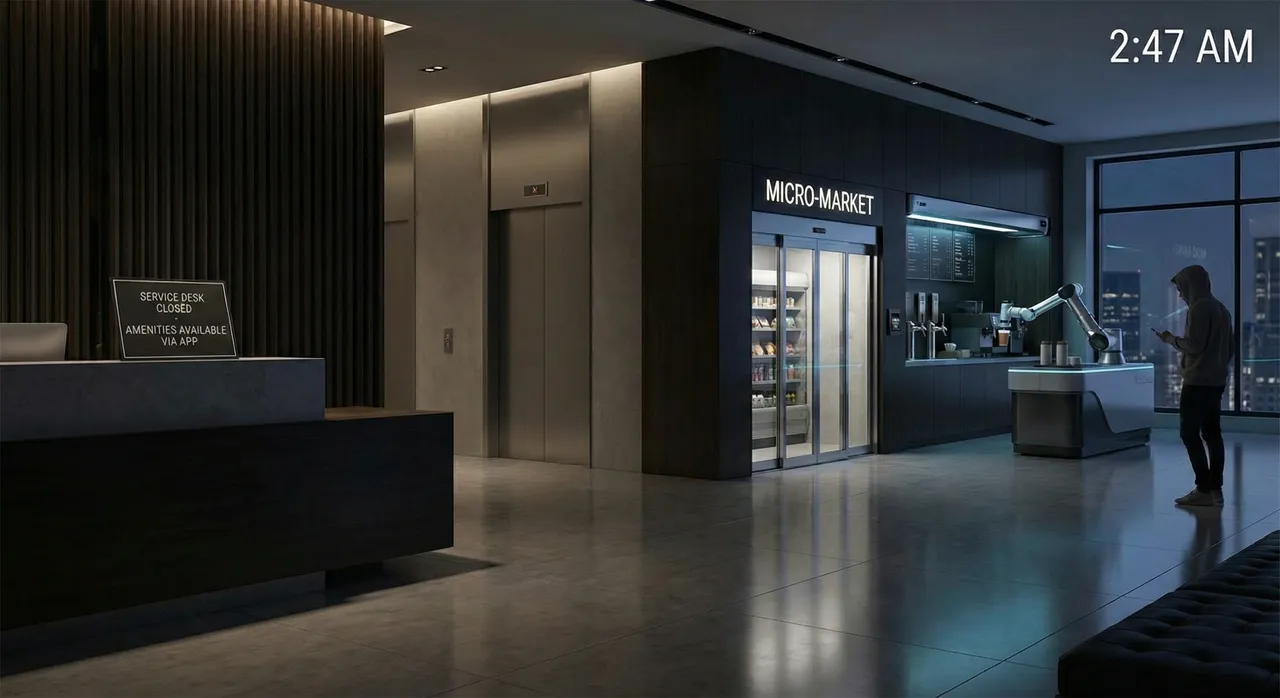
For decades, the promise of the full-service hotel was simple: “Always On.” A club sandwich at 2:00 AM or a fresh towel at 4:00 AM weren’t just perks; they were implicit guarantees of the luxury and upscale sectors.
But in 2025, that promise has fractured.
The industry is currently grappling with a phenomenon known as the “Midnight Void.” Unable to staff night shifts profitably due to a chronic labor shortage and wage inflation, hotels are simply shutting down operations after 10:00 PM. Kitchens go dark, lobbies become ghost towns, and amenities that once drove value are shuttered.
This retrenchment creates a perilous friction. Modern guests, driven by the “Amazon effect,” expect hyper-convenience. When they arrive at midnight to find a closed kitchen, the result is a degradation of brand equity and a sharp drop in Net Promoter Scores (NPS).
The Math of the Night Shift
The root of the “Midnight Void” is a broken financial model. The labor shortage is not temporary; it is structural. As of 2025, the hotel sector remains approximately 200,000 jobs below 2019 levels.
To attract talent to the “graveyard shift,” hotels have engaged in an unprecedented wage escalation. The cost of maintaining a human staff at night has ballooned, with the break-even point for a human-staffed night kitchen moving beyond the reach of most properties.
This has created a massive Financial Arbitrage opportunity for automation:
- The Human Cost: To fully staff a single “night runner” position 24/7 requires roughly 4.2 Full-Time Equivalents (FTEs) to cover all shifts, weekends, and holidays. This pushes the total annual cost to over $200,000.
- The Robot Cost: A single service robot (like a Relay or Tug) can be leased for approximately $25,000 per year.
Even with redundancy, the savings exceed $150,000 annually per position. The math is undeniable: automation has become the only viable way to keep the lights on.
Amenity-as-a-Service (AaaS)
The solution isn’t just about cutting costs; it’s about turning dead space into revenue. This is the rise of Amenity-as-a-Service (AaaS).
Hotels are transforming lobbies from passive waiting rooms into automated profit centers.
- The Smart Market: Replacing the dusty corner shop with AI-powered “Micro-Markets” (using tech like Amazon Just Walk Out). These systems operate 24/7 without a cashier, tracking inventory automatically. Data shows these markets can drive a 49% increase in revenue with profit margins reaching 62%.
- Wellness on Demand: Monetizing quiet zones with pay-per-use sleep pods or in-room commercial fitness equipment (like Peloton).
By treating amenities as autonomous business units, hotels can capture the revenue that currently leaks to the gig economy (UberEats/DoorDash) when guests are forced to order out.
The Psychology of 2:00 AM
One of the biggest fears hoteliers have is that robots will feel “cold” or “impersonal.” However, research into the Service Robot Acceptance Model (sRAM) suggests the opposite is true for the night shift.
At 2:00 AM, guests are driven by Perceived Usefulness, not a desire for social interaction. They are tired, they are hungry, and they want efficiency.
- The “Virus Assassination” Effect: Post-pandemic, robots are viewed as agents of safety. A contactless delivery from a robot is often preferred over an interaction with a stranger, offering a “hygiene assurance” that mitigates the lack of human warmth.
- Speed Over Chat: If a robot can deliver a toothbrush in 10 minutes while the overwhelmed human night auditor takes 45, the robot wins on satisfaction.
The Hybrid Future
The goal isn’t a “staff-less” hotel; it’s a “staff-optimized” one.
Cases like Alibaba’s FlyZoo hotel in China showed that removing all humans can make the experience feel transactional and cold. Conversely, Sheraton and Yotel have found success by using robots to handle the logistics - hauling luggage and running room service - allowing the limited human staff to remain at the front desk, focusing on security and complex guest needs.
The “Midnight Void” is a wake-up call. The future of hospitality is not about replacing humans; it is about elevating them by automating the drudgery of the night, ensuring that even at 4:00 AM, the hotel is truly “Always On.”
References
- The Midnight Void: Mitigating the Night-Shift Labor Crisis in Hospitality (Internal Research Document).
- American Hotel & Lodging Association: 2025 State of the Industry Report.
- Journal of Tourism Futures: Robots in service experiences: negotiating food tourism in pandemic futures.
- ZipRecruiter: Hotel Line Cook Salary: Hourly Rate January 2026 USA.
- Hotel Tech Report: How to Run Your Hotel Retail Like Amazon with Impulsify.
- J.D. Power: 2025 North America Third-Party Hotel Management Guest Satisfaction Benchmark.
- Oracle: Hospitality in 2025: Automated, Intelligent… and More Personal.
Read next: Robot baristas for hotels and resorts — machine choice, floor loading, and the volume an overnight installation needs to clear. Or start with the robot barista buyer’s guide.