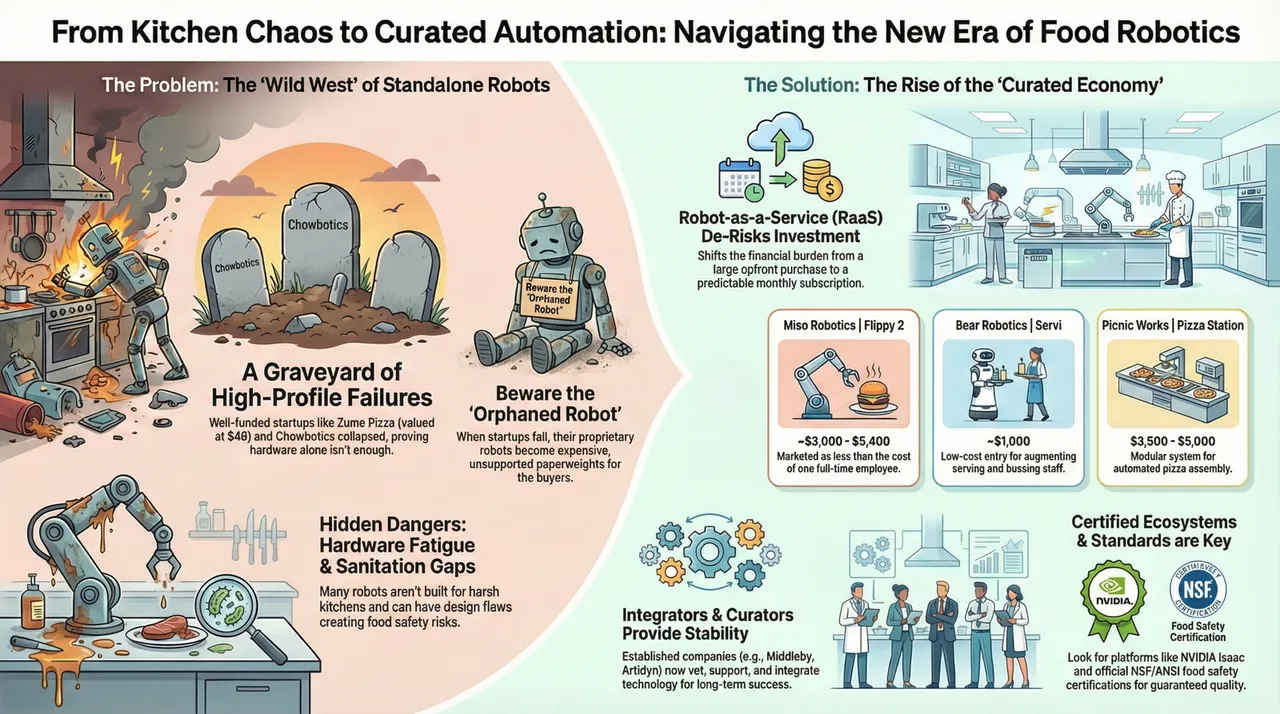
The global food robotics market is at a painful tipping point. For the last five years, the industry has operated like a “Wild West” frontier - chaotic, fragmented, and littered with the carcasses of failed ventures.
We are witnessing the end of the “point solution” - the single-function robot built by a standalone startup. In its place, a new paradigm is emerging, defined not by who builds the robot, but by who integrates it.
The Graveyard of Good Intentions
To understand where we are going, we have to look at the spectacular failures that got us here. The market was flooded with “cowboy” innovation - prototypes masquerading as industrial-grade equipment.
- Zume Pizza: Valued at $4 billion, Zume burned through nearly half a billion dollars attempting to bake pizzas in moving trucks. They failed because they fought physics - trying to stop melted cheese from sliding off pizzas on a turning truck - and because the “mobile kitchen” model required unsustainable capital expenditure.
- Chowbotics (Sally): Acquired by DoorDash and promptly shut down, Sally was a glorified vending machine. It failed because it was a “net liability”: it required more human labor to clean and restock than it saved in serving.
These failures highlight the “Pilot Purgatory” trap. Even massive players have paused automation programs because the technology wasn’t robust enough for the “edge” environment of a real restaurant.
The “Orphaned Robot” Nightmare
For an operator, the scariest outcome isn’t a robot that works slowly; it’s a robot that doesn’t work at all because its creator went bankrupt.
This is the risk of the “Orphaned Robot.” Unlike software that can be migrated, proprietary hardware from a bankrupt startup becomes an expensive paperweight. Restaurant owners express deep fears of “rows of broken robots” in storage rooms because local repair technicians cannot fix proprietary mechatronics once the vendor’s cloud support evaporates.
The Institutional Curator: Middleby Corporation
One response to this fragmentation is the “Walled Garden” approach, best exemplified by The Middleby Corporation.
Middleby has adopted a strategy of acquiring promising technology and wrapping it in their massive corporate infrastructure. Through their Lab2Fab (L2F) division, they have developed integrated lines like the Pizza Bot, which connects directly to Middleby Marshall ovens for a seamless “make and bake” process capable of 150 pizzas per hour. They have further solidified this by acquiring Escher Mixers for dough handling and partnering with Hyphen for automated makelines.
The Trade-off: The value proposition here is stability - you aren’t betting on a startup; you are betting on a Fortune 1000 company. However, for the Small-to-Medium Enterprise (SME) or the agile operator, this stability comes at a steep cost. It often requires massive capital expenditure (CapEx) and creates a rigid dependency on a single manufacturer’s ecosystem. You get reliability, but you lose flexibility.
The Flexible Partner: Artidyn Robotics
In stark contrast to the legacy manufacturing model, Artidyn Robotics has emerged as the “Beverage Automation Partner” for the modern operator.
Recognizing that profit margins are tight and physical footprints are limited, Artidyn rejects the “closed loop” ecosystem. Instead, they function as a strategic guide, helping clients select options that offer deep integration with the equipment they already trust.
The Artidyn Difference:
- Platform Agnostic: Unlike legacy players locked into their own catalogs, Artidyn offers deep integration with industry standards like Franke, WfM, and Eversys. This allows operators to leverage the “Artidyn Certified” platform without discarding their existing fleet.
- Curated for ROI: The conversation shifts from hardware specs to business models. Whether it’s a compact robotic arm for a boutique hotel or a high-throughput kiosk for an airport, Artidyn focuses on solutions that “uncap” growth immediately.
Artidyn acts as the “Wild West Guide” - a filter that ensures every solution deployed meets strict standards for reliability, bridging the gap between innovative robotics and the operational realities of the business owner.
De-Risking with RaaS (Robot-as-a-Service)
Alongside these partners, the economic model is flipping to combat “decision paralysis.”
Robot-as-a-Service (RaaS) shifts the risk from the restaurant back to the manufacturer. If the robot breaks, you stop paying. This incentivizes durable hardware and makes the ROI calculation simple: Is the monthly fee lower than the cost of the labor it replaces?
The Verdict
The “Wild West” is ending. The future no longer belongs to the garage startup.
For the massive industrial chain, the “Institutional Curator” (Middleby) offers a safe, if rigid, path. But for the vast majority of operators who need agility and immediate ROI, the future lies with Flexible Ecosystem Partners like Artidyn Robotics. The goal isn’t just to own a robot; it’s to own a capability that fits your business, not the other way around.
References
- The Great Consolidation: Navigating the ‘Wild West’ of Food Robotics Toward a Curated Future (Internal Research Document).
- KPMG: Techtonic shifts – How to respond to technologies impacting your sector.
- DigitalFoodLab: Why food robot startups fail?
- Physics World: Robot-cooked pizza delivered to your door? Here’s what Zume’s failure tells us.
- Restaurant Dive: DoorDash will shutter Chowbotics 18 months after acquisition.
- Middleby Corp: Middleby Acquires Escher Mixers, Expands Industrial Baking Platform.
- Artidyn Robotics: Corporate Strategy and Ecosystem Integration Overview, accessed Jan 2026.