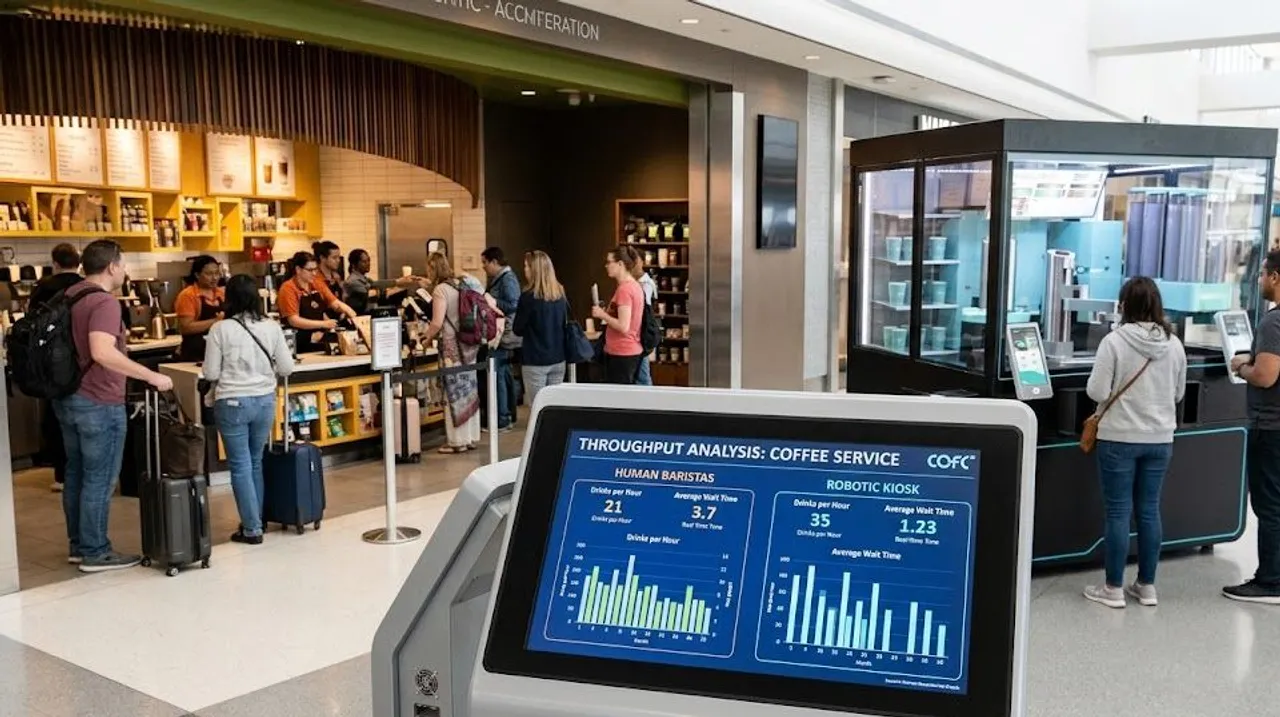
“Unattended” is the word that sells these machines and it is the word that causes most of the disappointment. It is accurate about staffing and misleading about work. A robot cafe does not need someone standing behind it during trading hours. It still needs someone, most days, doing a job that has a name and a duration.
If you are weighing a placement, the useful question is not whether the machine runs without a barista. It does. The question is what the remaining work costs you, and whether the site’s volume covers it.
The daily round is the job
At any real volume, an unattended site needs a visit every day. Beans, milk, cups, lids, syrups. Waste emptied. Surfaces wiped. The automated rinse cycles handle the milk lines between serves, and they genuinely work — they do not remove the stop.
Plan on 30 to 45 minutes on site for a machine trading at a few dozen cups a day, plus drive time. That range is our operating assumption rather than an audited average across a large fleet, and the top of it is where you should budget: the visit is slower when something has gone wrong, and something goes wrong often enough to matter.
The important property of this number is that it is fixed per machine, not per cup. A robot at 55 cups a day and a vending unit at 15 both consume one stop. That single fact drives almost everything else about operating these machines, and it is why the case for a robot cafe is a volume case rather than a technology case.
What that means for a route
Two consequences follow, and operators discover both the expensive way.
Isolated placements carry their own drive time. One machine at the far end of a route puts the whole journey against a single site’s contribution. Three within a few miles change the arithmetic completely. Cluster deliberately, even if it means turning down a good site in the wrong place.
Telemetry replans the route; it does not remove the visit. Stock levels, sales, and faults report across the fleet, so you can plan against real consumption instead of a fixed timetable and stop driving to a machine that does not need you. That is a real saving and it is the main operational argument for a connected machine over a dumb one. It is not remote operation.
A fleet without telemetry becomes an unplannable driving job. That is the honest description.
The economics, at one site
Our worked illustration for an operator-owned machine on someone else’s floor, at a 15% site share:
| Cups per day | 55 |
| Average ticket | $4.00 |
| Net per day | $133 |
| Payback | 6.7 months |
That is roughly $4,000 a month net from one placement, after consumables, card processing, the site share, the daily visit, and utilities. The full model and its assumptions are published rather than summarised, because the figure moves hard with volume and we would rather you checked it than trusted it. These are modelled figures, not audited results.
The number that decides a site is cups per day, and it is the one number sites routinely overstate. Meter it, or place on revenue share until you have your own data. Taking a landlord’s footfall claim at face value is the most reliable way to strand a $27,000 machine.
What actually fails
Not the robot arm. In ordinary operation the mechanical side is the least of it. What takes a site offline, roughly in order of how often we see it:
- Consumables running out early. A day that beats forecast empties the milk before the next visit. Telemetry warns you; a route with no slack in it cannot act on the warning.
- Cups and lids. Unglamorous and the most common cause of a machine standing idle with everything else working.
- Network. No connectivity means no card authorisation, which means no sales even though the machine is otherwise fine. Confirm coverage at the exact pitch before you commit, not at the building entrance.
- Payment hardware. Reader faults are rare but they take the whole site’s revenue to zero while they last, so they belong in your spares thinking.
- Waste bin full. Trivial, and it stops service.
Notice that four of those five are logistics, not engineering. That is the character of this business.
Uptime, honestly
Plan a site on the assumption that it trades reliably during the hours you have stocked it for, and that a bad day costs you the remainder of that day rather than an hour. The recovery time for most of the failures above is “the next visit”, unless you can get someone there sooner.
This is why a named owner for the round matters more than any specification on the datasheet. If nobody owns the daily visit by name, the machine will be out of milk within a month. We see this fail far more often than we see hardware fail.
Which format survives unattended
Only a fully enclosed machine belongs on an unattended public pitch. The Iris is the route default: enclosed, 70 cups an hour, 32 presets, rated for unattended public operation, $27,000. Iris Max suits a site that justifies a differentiated offer — six syrup lines and latte-art printing, at a slower 72-second serve. Iris Pro is the narrowest cabinet, for a pitch where an existing alcove sets the width.
Open-bar craft machines are the wrong format here. They are good machines and they want supervision.
Before you commit a machine
- Realistic cups per day, measured or evidenced, not the site’s estimate
- A ticket the location supports — the specialty price is doing the work
- A dedicated circuit, and a written answer on who pays to install it
- Floor loading for 720–750 kg, and a delivery route the crate fits through
- Water, or an accepted tanked operation with refill built into the round
- Network coverage good enough for telemetry and card authorisation
- Site share and contract length — a short term on a capital machine is a bad trade
- A spares position, and where parts ship from. One controller on a long lead time can strand a site for a quarter.
The honest summary
An unattended robot cafe is a good business at a site with genuine footfall, a ticket the location supports, and a route that already passes nearby. It sells a specialty drink at a specialty price with no barista on the payroll, and at 55 cups a day it pays for itself inside a year.
At a site without those things it is an expensive way to make coffee that someone still has to visit every day. The technology is not what decides which one you have — the cups per day are, and you can know that number before you buy.
Send us your best site and your median one. We will model both on the same assumptions and tell you which tier of machine, if any, the route can carry — including when the answer is that it cannot.
Read next: Robotic coffee kiosks for vending operators works through route economics and site qualification in detail. For the wider category, see the robot barista buyer’s guide and what a robot barista costs.